
If you are searching for Test.com pricing enterprise plans, there is an important naming detail to clear up before looking at the numbers.
The enterprise testing product associated with Test.com, Inc. is Gauge Online. Gauge describes itself as a platform for online testing, professional certification, credentialing, training, proctoring, and related workflows. Its terms identify Gauge as a division of Test.com, Inc.
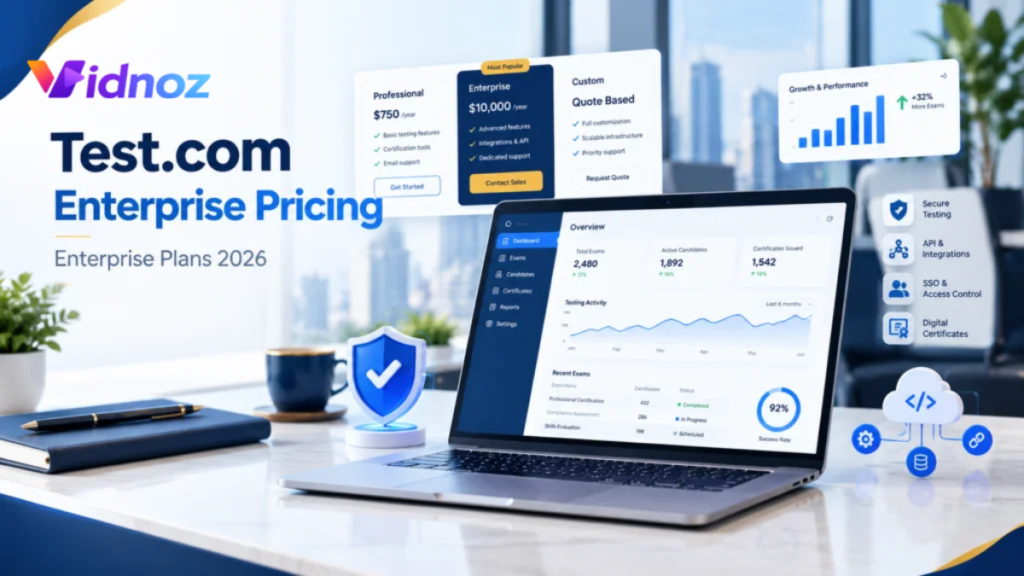
For organizations evaluating the software, Gauge currently publishes an Enterprise starting price of $10,000 per year, plus $1,000 per year for hosting and a $2,000 one-time setup fee. Using those published starting figures, the basic first-year calculation is $13,000.
That number is useful—but it is not the same thing as saying every enterprise customer will receive a $13,000 invoice.
The more important question is how the pricing works once you factor in exam volume, modules, integrations, proctoring, and the way your organization actually runs its testing program.
This guide breaks that down without treating a published starting price as a guaranteed quotation.
Quick answer: How much does Test.com Enterprise cost?
If by “Test.com” you mean the Gauge Online testing and certification platform, the currently published Enterprise starting figures are:
| Cost component | Published starting amount |
| Enterprise software | $10,000/year |
| Enterprise hosting | $1,000/year |
| One-time setup | $2,000 |
| Basic first-year calculation | $13,000 |
| Software + hosting after setup | $11,000/year |
Gauge says Enterprise is intended for organizations requiring more than 10,000 tests per year. It also states that qualifying Enterprise programs move to volume-based pricing, starting at $3 per test, with the price decreasing as volume increases. Gauge says its highest-volume customers pay well under $1 per test.
The distinction matters:
$10,000 is the published starting software price—not a universal all-in Enterprise quote.
First, make sure you are pricing the right “Test.com”
There are two different things a reader can encounter when searching for “test.com.”
Test.com, Inc. and Gauge
Gauge Online is the relevant software product for organizations looking for an online testing and certification platform. Gauge’s terms state that Gauge is a division of Test.com, Inc.
The platform is aimed at professional certification bodies, credentialing organizations, training providers, government-related programs, and businesses that need more than a basic quiz builder. Its current product information covers testing, certification and badging, proctoring, lessons, eCommerce, and developer integrations.
The test.com domain is a separate issue
The test.com domain itself is not an Enterprise software subscription.
At the time of this article’s review, the domain was listed for sale on Atom for $4 million as a one-time purchase. That is a domain acquisition price, not the price of Gauge’s enterprise testing software.
That distinction is worth making because someone researching “test.com pricing” could otherwise mistake a domain listing for SaaS pricing.
If your goal is to buy testing and certification software, the relevant pricing discussion is Gauge.
What does the $13,000 first-year figure actually mean?
The arithmetic is straightforward:
$10,000 software + $1,000 hosting + $2,000 setup = $13,000
But it is better to call this a published starting calculation than a guaranteed first-year price.
Why?
Because Gauge explicitly describes Enterprise pricing around an organization’s testing volume and required modules. Its pricing page tells organizations running more than 10,000 exams per year to move into volume pricing and build a plan around their actual program.
That means a procurement team should avoid putting “$13,000 total cost” into a budget document without qualification.
A better internal note would be:
“Gauge Enterprise has a published starting structure of $10,000/year software + $1,000/year hosting + $2,000 setup, subject to volume and program requirements.”
That wording preserves the useful public price without turning a starting point into a promise.
What happens after the first year?
Using the same published starting figures, the recurring software and hosting components add up to:
$10,000 + $1,000 = $11,000 per year
The $2,000 setup fee is described as a one-time charge, so it is not included in that simple recurring calculation.
However, buyers should not assume that every renewal will automatically be exactly $11,000.
The Enterprise model incorporates testing volume, and Gauge says high-volume programs move into volume-based pricing. Your organization’s contract and actual usage therefore matter more than a simple year-two multiplication.
This is an important distinction when comparing vendors. A platform with a lower headline subscription can still produce a higher effective cost if it charges separately for capabilities your program requires.
How does Enterprise volume pricing work?
This is probably the most important part of the pricing model for a large testing operation.
Gauge says Enterprise is designed for organizations conducting more than 10,000 tests per year. It states that Enterprise volume pricing starts at $3 per test and decreases as volume increases. Gauge also says its highest-volume customers pay well under $1 per test.
That does not mean you should simply multiply $3 by your expected number of exams and call the result your annual bill.
The published Enterprise price already has a software and hosting structure, while the company describes volume pricing as part of its Enterprise model. The actual commercial arrangement should therefore be confirmed with Gauge for the specific testing program.
Why test volume matters
Consider two hypothetical organizations:
Organization A runs 11,000 certification exams annually.
Organization B runs 100,000 exams annually.
Both technically fall into the high-volume Enterprise category, but their operational requirements are very different.
Organization A may be primarily concerned with having a reliable certification platform and the necessary integrations.
Organization B may care much more about peak concurrency, automated workflows, candidate registration, proctoring volume, credential issuance, data synchronization, and the economics of each additional exam.
This is why enterprise buyers should discuss annual volume and expected growth, rather than asking only, “What is the Enterprise subscription?”
What is included in the Enterprise plan?
Gauge currently lists several capabilities alongside its Enterprise offering:
- Certification and badging
- Proctoring integration
- Lessons
- eCommerce
- Developer tools and integrations
The Enterprise offering is also positioned for organizations running more than 10,000 tests annually.
The important practical point is that Enterprise is not simply a larger version of a consumer quiz application.
It is intended to support a broader testing lifecycle.
Certification and badging
For organizations issuing professional credentials, passing an exam is often only one step.
Gauge’s certification functionality supports automated certificate delivery, expiration dates, renewal notifications, and branded certificates.
That can matter when the organization has thousands of credential holders and wants to avoid manually issuing and tracking certificates.
Proctoring
Proctoring is particularly important for high-stakes examinations.
Gauge says its platform integrates with several proctoring providers and supports both remote and on-site proctored testing. It describes options involving ProctorFree, ProctorU, HonorLock, and MonitorEDU, as well as its GaugeLive functionality for on-site exams.
But there is an important pricing consideration here:
Do not automatically interpret “proctoring integration” as “all proctoring is included in the $10,000 software price.”
Gauge describes different purchasing arrangements for proctoring, including bundles, per-exam purchasing, and arrangements where the test taker pays.
If your organization requires proctored exams, ask for the proctoring cost separately in the quotation.
Developer integrations
For enterprise buyers, integrations may be more important than another feature on a checklist.
Gauge says it supports REST API access, webhooks, and single sign-on. Its enterprise information specifically discusses connecting the testing system with existing LMS, CRM, HR, or other internal systems.
This matters because the real cost of a testing platform is not limited to the subscription.
If candidates, exam results, credentials, payments, and user accounts have to be moved manually between systems, your staff may pay the difference in labor.
Professional vs. Enterprise pricing
Gauge currently publishes both Professional and Enterprise pricing.
| Professional | Enterprise | |
| Software starting price | $750/year | $10,000/year |
| Hosting | $250/year | $1,000/year |
| Setup | $500 one-time | $2,000 one-time |
| Positioning | Growing credentialing programs | Large-scale certification programs |
| Published Enterprise threshold | — | More than 10,000 tests/year |
| Certification & badging | Available according to selected features | Listed |
| Proctoring integration | Available according to configuration | Listed |
| Developer tools/integrations | Available according to configuration | Listed |
Gauge describes Professional as having eight usage-based pricing levels, while Enterprise is designed around larger-scale programs and volume pricing.
A simple example
Suppose an organization expects to administer only a few hundred exams annually.
Jumping directly to Enterprise would require a very different justification than it would for an organization administering tens of thousands of exams.
For the smaller organization, the Professional pricing structure may be the more relevant starting point.
For the larger organization, the question becomes less about the headline subscription and more about:
- volume;
- required modules;
- integrations;
- proctoring;
- certification workflows;
- implementation;
- security requirements; and
- expected growth.
The point is not that one plan is universally better. The appropriate pricing structure depends on the program being operated.
What should you ask before requesting an Enterprise quote?
A useful quote request should contain enough information for the vendor to price the actual operation rather than giving you a generic starting figure.
1. How many exams will you run?
Give both current and expected future volume.
For example:
- 15,000 exams in year one
- 25,000 expected in year two
- 40,000 possible at maturity
That gives the vendor a better picture than simply saying “large volume.”
2. How many exams require proctoring?
Separate ordinary exams from high-stakes exams.
For example:
- 20,000 total annual exams
- 8,000 remotely proctored
- 2,000 requiring live human proctoring
That distinction can materially change your cost model.
3. Which systems must connect to Gauge?
List your actual systems:
- LMS
- CRM
- HR platform
- identity provider
- payment system
- website
- data warehouse
Gauge advertises API, webhook, and SSO capabilities, but your procurement team should establish exactly what integration work is included and what your own development team must handle.
4. How will candidates pay?
If you charge candidates for exams or certifications, ask about the complete payment workflow.
Gauge provides eCommerce functionality and supports merchant-account connections, including Stripe and PayPal Express according to its support documentation.
The important question for budgeting is not simply whether payment processing exists. Ask which transaction fees, merchant fees, implementation work, or external charges sit outside the software subscription.
5. What happens if your volume changes?
Enterprise testing programs rarely remain perfectly flat.
Ask:
- What happens if annual volume doubles?
- What happens if volume falls?
- How are additional exams priced?
- When does a different pricing tier apply?
- Can pricing be renegotiated as the program grows?
Gauge says its Enterprise model is built around actual exam volume and that volume pricing decreases as volume increases.
Is there a free trial?
Yes.
Gauge currently advertises a 30-day free trial with no credit card required. It also says its plans include white-glove support.
For an enterprise buyer, however, a trial should not be treated as a substitute for technical due diligence.
A useful evaluation would involve testing the workflows that matter to your organization.
For example:
- Import a representative question bank.
- Build one ordinary exam.
- Build one high-stakes exam.
- Test your candidate registration process.
- Test the reporting you actually need.
- Verify your authentication or SSO requirements.
- Test the certification workflow.
- Confirm how proctoring is initiated.
- Examine the API documentation if integrations are important.
- Document which activities require vendor assistance.
That produces much more useful information than simply clicking through the interface.
What the public pricing does not tell you
The public pricing page is useful, but it does not answer every procurement question.
For example, the published starting price does not by itself tell a buyer exactly what their individual enterprise contract will cost after accounting for every implementation and usage requirement.
That is why the following should be confirmed in writing:
Implementation scope
Ask exactly what the setup fee covers.
Do not assume that “setup” means every integration, migration, configuration, training session, and custom development project is included.
Proctoring costs
If proctoring is essential, request those costs separately.
Gauge’s documentation describes several proctoring purchasing arrangements, so the final economics depend on how your program uses the service.
Integration work
An API being available does not necessarily mean that building your integration is free.
Ask who is responsible for development, testing, maintenance, and troubleshooting.
Contract terms
Gauge’s terms state that a client-specific Service Provider Agreement controls if it conflicts with the general website terms.
That is another reason to review the actual agreement rather than relying entirely on public web-page pricing.
A better way to calculate your real budget
Instead of recording one number called “Test.com Enterprise cost,” build a small cost model.
For example:
Platform
- Enterprise software
- Hosting
- Setup
Usage
- Exam volume
- Additional or volume-based charges
Security
- Proctoring
- Identity verification, if required
- Other security services
Technical
- Integration development
- Data migration
- SSO implementation
- Internal engineering time
Operations
- Staff administration
- Candidate support
- Certification administration
The last category is particularly easy to overlook.
A platform that costs more but eliminates substantial manual administration may have a different total operating cost from a cheaper platform that requires employees to maintain spreadsheets and move records between systems.
That is not a claim that Gauge will necessarily reduce those costs. It is simply the right way to evaluate enterprise software: compare the complete workflow, not only the subscription price.
Bottom line on Test.com Enterprise pricing
For buyers searching for Test.com Enterprise pricing, the relevant product is currently Gauge Online, a division of Test.com, Inc.
Gauge’s public pricing currently gives Enterprise a starting point of:
- $10,000/year for software
- $1,000/year for hosting
- $2,000 one-time for setup
That produces a straightforward $13,000 first-year starting calculation, while the same published software and hosting figures equal $11,000 annually before considering changes in usage or other requirements.
For organizations running more than 10,000 tests per year, Gauge describes a volume-based model beginning at $3 per test and decreasing as volume rises.
The practical takeaway is therefore not “Test.com costs $13,000.”
It is:
Gauge Enterprise has a published starting structure that can be used for initial budgeting, but organizations should obtain a program-specific quotation based on exam volume, modules, proctoring, integrations, and implementation requirements.
And if you are comparing it with another testing platform, put those same cost categories into the other vendor’s quote. That is the only meaningful way to determine whether two apparently different prices are actually comparable.